Determining the Ram Pressure Profile#
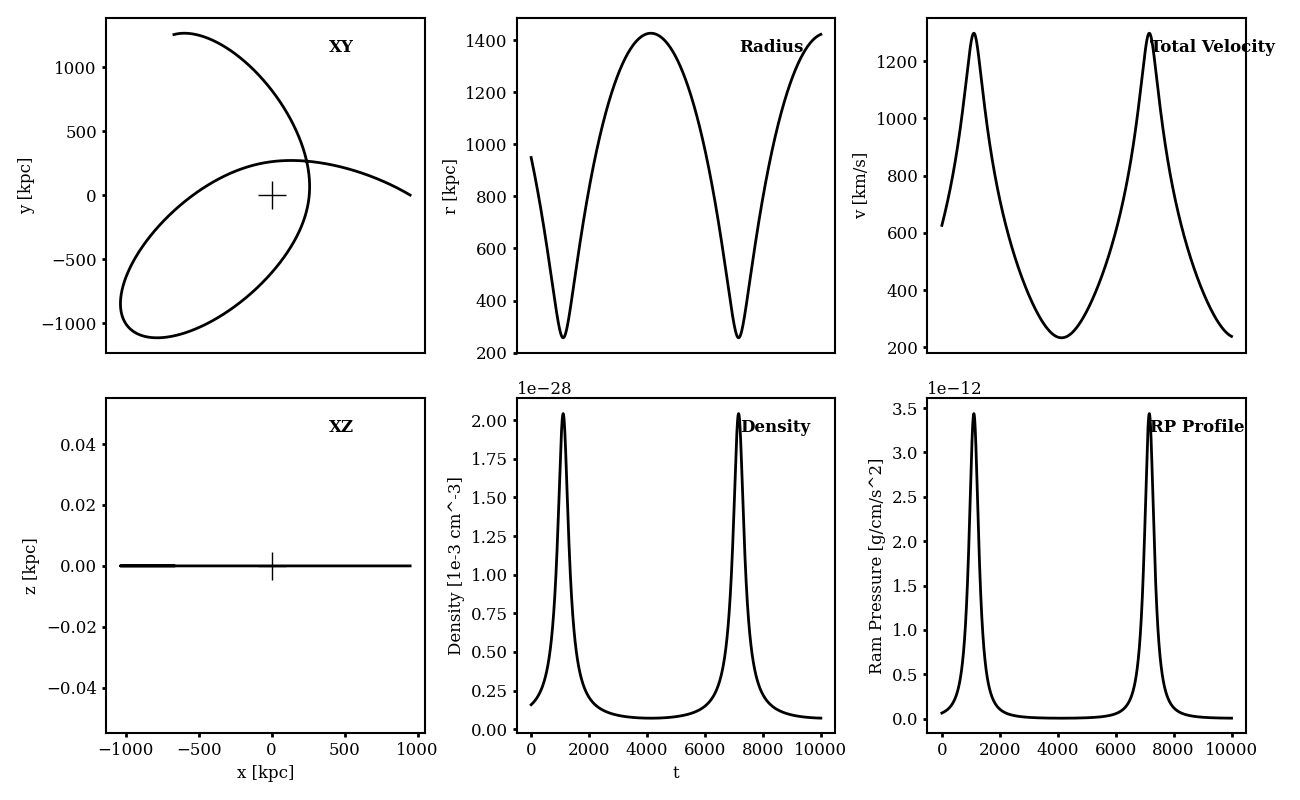
The key factor for a ram pressure interaction is the ram pressure profile. An infalling galaxy will experience a time-variable wind strength. The ram pressure goes as \(P_\text{ram} = \rho v^2\). As a galaxy approaches pericenter, both the local medium density and the velocity increases to a peak at pericenter, where it then steadily decreases. Therefore, implementing a time-variable strength of ram pressure on a galaxy is considerably more physically realistic than a more simple constant wind.
Getting a Ram Pressure Profile from an Infalling Orbit#
GalaRP has built-in classes to make this proceess seamless and easy for users, whether they want to initialize a ram pressure profile from a Gala-integrated infalling orbit, or manually defining the profile
A typical density profile for a galaxy cluster is given by the Beta profile:
where \(n_0\) is the central density and \(r_c\) is the core radius. This can be converted into a mass density by assuming a gas mass, commonly by multiplying by an atomic mass unit (in grams) to assume ionized atomic Hydrogen.
To make a ram pressure profile, we can use the GalaRP HostOrbit class. To make complete use of this class we have to specify the host potential, the initial position and velocity conditions, and the host density model. Like with some of our other examples, we will use initial conditions given in Zhu+2023.
import galarp as grp

test_host_potential = grp.builtins.JZ2023_1e14()
init_conditions = grp.builtins.JZ2023_1e14_IC()

host_1e14 = grp.HostOrbit(potential=test_host_potential,
                        init_conditions=init_conditions,
                        density=grp.SphericalBetaModel())
To generate our orbit, simply call host.integrate() on your HostOrbit object. You can also generate a simple
plot showing the orbit, along with the computed density and ram pressure profiles.
host_1e14.integrate(n_steps=10000)          # Integrate orbits
host_1e14.plot_infall_orbit()               # Plot orbits